
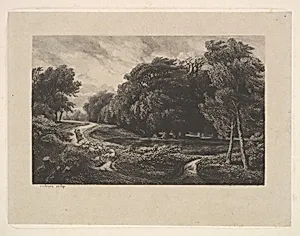
The Approaching Storm
Medium
Etching; first state of two
Dimensions
Image: 4 1/4 × 6 3/4 in. (10.8 × 17.1 cm) Plate: 6 1/4 × 8 1/4 in. (15.9 × 21 cm) Sheet: 7 3/4 × 10 3/8 in. (19.7 × 26.4 cm)
Classification
Prints
Department
Drawings and Prints
Museum
Metropolitan Museum of Art, New York, NY
Credit
Gift of Theodore De Witt, 1923
Accession Number
23.65.69
Rights
Public Domain
Tags
Art Historical Context
Charles-François Daubigny *The Approaching Storm (1844) is a captivating etching that evokes the drama of an impending tempest in the French countryside. In this first state of two rare, unaltered proof—the artist renders a rural road winding through trees, with human figures and animals caught in hurried motion against brooding skies. The intimate scale (image: 4¼ × 6¾ in.) draws viewers into the scene’s urgency, blending everyday life with nature’s sublime force. Daubigny, a key figure in the Barbizon school, pioneered plein-air painting and influenced Impressionism with his luminous landscapes. Created early in his career, this print showcases his etching prowess: fine, fluid lines etched into a copper plate, bitten by acid to create rich tonal contrasts that mimic gathering clouds and wind-swept foliage. Etchings like this allowed artists to disseminate ideas affordably, bridging Romanticism’s emotional intensity with Realism’s direct observation. Housed in the Metropolitan Museum of Art’s Drawings and Prints department (gift of Theodore De Witt, 1923), the work highlights Daubigny’s lifelong fascination with atmospheric effects, foreshadowing his celebrated oil paintings of the Seine Valley. A testament to 19th-century printmaking’s artistry, it invites us to pause and feel the storm’s approach.
About the Artist
Charles-François Daubigny · 1817–1878
Charles-François Daubigny was born on February 15, 1817, in Paris into a family of artists, with his father, Edmé-François Daubigny, a classical landscape painter, and his uncle, Pierre Daubigny, a miniaturist, providing his initial artistic training. He further studied under Jean-Victor Bertin, Jacques Raymond Brascassat, and Paul Delaroche at the École des Beaux-Arts, though he quickly moved bey...