
The Ark
Medium
Oil on canvas
Dimensions
46 1/4 x 61 1/4 in. (117.5 x 155.6 cm)
Classification
Painting
Culture
American
Department
The American Wing
Museum
Metropolitan Museum of Art, New York, NY
Credit
Gift of James DeLancey Verplanck and John Bayard Rodgers Verplanck, 1939
Accession Number
39.184.20
Rights
Public Domain
Tags
Art Historical Context
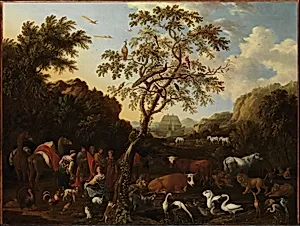
**The Ark**, painted around 1700 by Lodewijk Tieling, an active in the late 1690s, captures a whimsical vision of the biblical Noah's Ark story in oil on canvas. Measuring an impressive 46¼ x 61¼ inches, this large-scale work teems with life: pairs of men and women guide an extraordinary menagerie including swans, ducks, unicorns, peacocks camels, cats, cows, dogs, goats,, monkeys, and lions toward the massive wooden vessel. The fantastical inclusion of unicorns blends scriptural narrative with folkloric imagination, characteristic of early colonial artistry. Created during America's colonial era, the painting reflects the period's rudimentary yet ambitious painting traditions, where oil on canvas—expensive and labor-intensive—signaled prestige among the emerging merchant class. Tieling's brief career (ca. 1695–1700) makes this a rare survivor of New World folk art, likely produced in a Dutch-influenced urban center like New York. Its naive style, with vibrant crowds and symbolic animal pairs, evokes the era's religious fervor and wonder at the natural world. Housed in the Metropolitan Museum of Art's American Wing since a 1939 gift from the Verplanck family, *The Ark* offers a charming window into 18th-century American culture—devout, diverse, and delightfully inventive. Visitors are drawn to its joyful chaos, a testament to how everyday artists brought epic tales to life.