
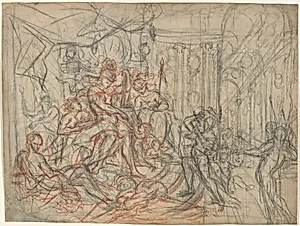
The Arming of Bellona
18th century
Medium
Red and black chalk
Dimensions
15 7/8 x 21 1/8 in. (40.4 x 53.7 cm)
Classification
Drawings
Department
Drawings and Prints
Museum
Metropolitan Museum of Art, New York, NY
Credit
The Elisha Whittelsey Collection, The Elisha Whittelsey Fund, 1968
Accession Number
68.729.5
Rights
Public Domain
Tags
Art Historical Context
In the opulent world of 18th-century Rococo art, *The Arming of Bell* by Juste-Aurèle Meissonnier (with attribution to Laurent Hubert) captures the dramatic mythological scene of Bellona, the Roman goddess war, being armed for battle. Created around the 1730s–1740s, this drawing reflects the era's fascination with classical deities reimagined in exuberant, dynamic poses. Meissonnier, a versatile architect, designer, and engraver, was renowned for his intricate ornamental designs that influenced silverwork, furniture, and architecture under Louis XV, blending fantasy with technical precision. Executed in red and black chalk on a generous sheet measuring 15 7/8 x 21 1/8 inches, the work showcases the artist's mastery of mixed-media techniques. Red chalk (sanguine) provides warm tonal modeling for flesh and drapery, while black chalk adds sharp contrasts and depth to the swirling human figures—warriors and attendants in theatrical motion. This combination allowed for fluid, expressive lines typical of preparatory studies, evoking the lively energy of Rococo while nodding to Baroque drama. Housed in the Metropolitan Museum of Art's Drawings and Prints department as part of The Elisha Whittelsey Collection (acquired 1968), this piece highlights the enduring value of sketches in revealing an artist's creative process. For visitors, it offers a window into how mythology fueled the decorative arts, bridging ancient lore with 18th-century elegance.
About the Artist
Laurent Hubert|Juste Aurèle Meissonnier (French|French) · 1780 |1695 –1780 |1750
French, died ca. 1780|French, Turin 1695–1750 Paris