
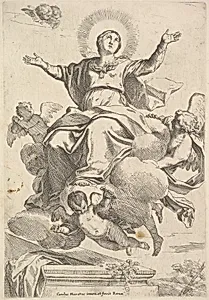
The Assumption of the Virgin
17th century
Medium
Etching; second state of three (Bartsch)
Dimensions
sheet: 10 9/16 x 7 11/16 in. (26.8 x 19.6 cm) plate: 8 7/16 x 5 13/16 in. (21.5 x 14.7 cm)
Classification
Prints
Department
Drawings and Prints
Museum
Metropolitan Museum of Art, New York, NY
Credit
Harris Brisbane Dick Fund, 1926
Accession Number
26.70.3(67)
Rights
Public Domain
Tags
Art Historical Context
Carlo Maratti’s *The Assumption of the Virgin* captures a cherished moment in Christian tradition, when the Virgin Mary is lifted heavenward by angels. Created in the 17th century as an etching, this print exemplifies the Baroque period’s deep engagement with religious subjects intended to inspire devotion and wonder. The scene’s dynamic arrangement of figures and flowing drapery draws viewers upward, mirroring the upward movement of the central narrative. As a print in its second state of three, the work highlights the technical possibilities of etching, a medium that allowed artists to achieve fine lines and rich tonal contrasts while making religious imagery widely accessible. Maratti, active during the height of Counter-Reformation art, used this technique to blend graceful composition with emotional immediacy, qualities that made his prints popular among collectors and worshippers alike. Today housed in the Metropolitan Museum of Art’s Department of Drawings and Prints, this impression entered the collection in 1926 through the Harris Brisbane Dick Fund. Its modest size—roughly the dimensions of a sheet of paper—belies the grandeur of its subject, reminding us how prints once carried sacred stories into homes and churches across Europe.
About the Artist
Carlo Maratti · 1625–1713
Son of a Dalmatian father. Known as the last major Italian artist of the classical tradition, which had originated with Raphael. He created a grandiose and decorative style that was valued by his ecclesiastical patrons. Comment on works: History; Religious.