
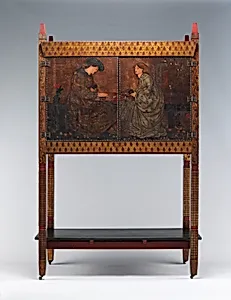
The Backgammon Players
Medium
Painted pine, oil paint on leather, brass, copper
Dimensions
Overall: 73 × 45 × 21 in. (185.4 × 114.3 × 53.3 cm)
Classification
Woodwork-Furniture|Paintings
Culture
British
Department
European Sculpture and Decorative Arts
Museum
Metropolitan Museum of Art, New York, NY
Credit
Rogers Fund, 1926
Accession Number
26.54
Rights
Public Domain
Tags
Art Historical Context
"The Backgammon Players" is a striking example of collaborative design from the early years of the Arts and Crafts movement. Created in 1861 by architect Philip Webb, painter Edward Burne-Jones, and the newly founded firm Morris, Marshall, Faulkner & Co., this painted pine cabinet features scenes of men and women engaged in the ancient game of backgammon. Burne-Jones contributed the oil-painted leather panels, while brass and copper fittings add both function and ornament. The work reflects the firm’s mission to unite fine art with everyday objects, reviving medieval craft traditions in Victorian Britain. At a time when industrial production dominated furniture making, this piece championed handcraftsmanship and artistic integration. Webb’s architectural sensibility shaped its bold form, while Burne-Jones’s Pre-Raphaelite style brought narrative richness to the gaming scenes. Displayed as both furniture and painting, it embodies the movement’s belief that beautiful, well-made objects could elevate daily life. Acquired by the Metropolitan Museum in 1926, the cabinet remains a vivid testament to the creative partnership that helped launch modern design reform.
About the Artist
Philip Webb|Sir Edward Burne-Jones|Morris, Marshall, Faulkner & Co. (British|British| |British) · 1850 |1834 | |1831 –1950 |1896 | |1915
London|British, Walthamstow, London 1834–1896 Hammersmith, London| |British, Oxford 1831–1915 West Sussex