
The Ballet Master
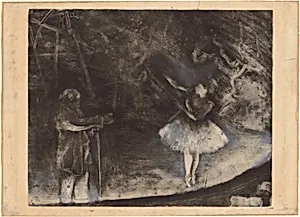
Medium
monotype (black ink) heightened and corrected with white chalk or wash on laid paper
Dimensions
plate: 56.5 x 70 cm (22 1/4 x 27 9/16 in.) sheet: 62 x 85 cm (24 7/16 x 33 7/16 in.)
Classification
Department
CG-E
Museum
National Gallery of Art, Washington, D.C.
Credit
Rosenwald Collection
Accession Number
1964.8.1782
Rights
Public Domain
Art Historical Context
Edgar Degas’s “The Ballet Master,” created around 1876 in collaboration with the amateur printmaker Vicomte Lepic, captures a quiet moment of instruction in a Parisian ballet studio. Degas, a central figure of the Impressionist circle, was fascinated by the daily life of dancers rather than their onstage glamour. Here he shows the ballet master guiding a young dancer, emphasizing the discipline and fleeting gestures that defined rehearsal. The work is a monotype, a printmaking process in which ink is applied to a metal plate and then transferred to paper under pressure. Degas heightened the image with white chalk or wash, creating luminous contrasts and a sense of movement. Because each monotype is essentially unique, the technique suited his desire to experiment with light and form while exploring modern subjects. Now in the National Gallery of Art’s Rosenwald Collection, “The Ballet Master” reveals Degas’s innovative spirit and his lifelong commitment to portraying the working world of ballet with both intimacy and technical daring.