
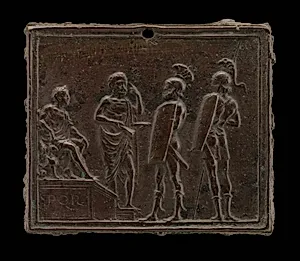
The Banishment of Coriolanus
1401 to 1500
Medium
bronze//Dark brown patina
Dimensions
overall: 4.4 x 5.1 cm (1 3/4 x 2 in.) gross weight: 43 gr
Classification
Sculpture
Department
CSD
Museum
National Gallery of Art, Washington, D.C.
Credit
Samuel H. Kress Collection
Accession Number
1957.14.271
Rights
Public Domain
Art Historical Context
This small bronze plaquette created sometime between 1401 and 1500, captures a dramatic moment from ancient Roman history: the banishment of the general Gaius Marcius Coriolanus. The unknown artist, known today as the Master of Coriolanus, chose a subject drawn from Plutarch that resonated strongly during the Renaissance, when classical stories of virtue, exile, and civic conflict were studied and admired. Cast in bronze with a rich dark brown patina, the piece measures just over four centimeters across, suggesting it was made as a portable collector’s item rather than a large public monument. Renaissance plaquettes like this one allowed patrons to own and contemplate scenes from antiquity in intimate settings. The compact format encouraged close looking, revealing the artist’s skill in modeling expressive figures and architectural details within a limited space. Such works were prized for both their narrative content and their technical refinement, bridging the worlds of sculpture and medal-making. Acquired by the National Gallery of Art as part of the Samuel H. Kress Collection, the plaquette remains a vivid reminder of how fifteenth-century artists revived and reinterpreted Roman moral tales for new audiences. Its modest size belies the depth of cultural meaning it carried for Renaissance collectors.