
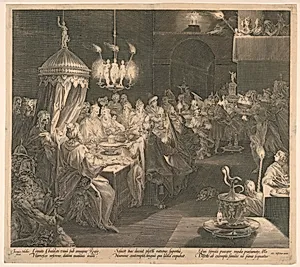
The Banquet of Belshazzar
ca. 1590–1620
Medium
Classification
Department
Smithsonian Collection
Museum
Smithsonian American Art Museum
Credit
Museum purchase through gift of Anonymous Donor
Accession Number
1948-39-3
Rights
Public Domain
About this artwork
Research in Progress
Art Historical Context
Visitors to the Smithsonian American Art Museum are invited to marvel at *The Banquet of Belshazzar*, a captivating print by Dutch artist Jan Harmensz Muller (1571–1628). Created around 1590–1620, this work draws from the dramatic biblical tale in the Book of Daniel, depicting the fateful feast where King Belshazzar witnesses a divine hand writing on the wall, foretelling the fall of Babylon. Muller's engraving captures this moment of hubris and divine judgment with intricate detail, a hallmark of Dutch Mannerism. As a master engraver from Haarlem, Muller was influenced by the Northern Renaissance and contemporaries like Hendrick Goltzius, blending elegant linework with theatrical composition. Prints like this one were revolutionary in the late 16th century, allowing wide dissemination of complex narratives to a broader audience beyond elite patrons. The medium's fine lines and tonal depth heighten the scene's opulence—gleaming vessels, lavish attire, and ominous prophecy—evoking both splendor and impending doom. Acquired through a generous anonymous gift, this piece reflects ongoing research into Muller's prolific output, underscoring his role in bridging Renaissance tradition with emerging Baroque drama. A testament to printmaking's cultural power, it reminds us how art immortalizes timeless stories of power and fate.