
The Bassoon with a French Horn Accompaniment
May 16, 1811
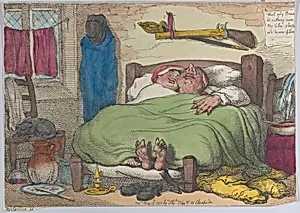
Medium
Hand-colored etching
Dimensions
Sheet (trimmed within plate): 8 11/16 × 12 1/2 in. (22 × 31.8 cm)
Classification
Prints
Department
Drawings and Prints
Museum
Metropolitan Museum of Art, New York, NY
Credit
The Elisha Whittelsey Collection, The Elisha Whittelsey Fund, 1959
Accession Number
59.533.2017
Rights
Public Domain
Tags
Art Historical Context
Thomas Rowlandson's *The Bassoon with a French Horn Accompaniment (1811), published by Thomas Tegg, a delightful example of Regency-era British satire captured in a hand-colored etching. Measuring about 8½ by 12½ inches, this print exemplifies Rowlandson's mastery of caricature, where exaggerated figures and witty scenarios lampooned social customs. Hand-coloring, a common enhancement for etchings at the time, added vibrant hues to heighten the humor, making these affordable prints hugely popular among the middle classes for their lively commentary on everyday life. The title playfully nods to musical instruments—a bassoon and French horn—likely deployed as cheeky double entendres in a bedroom scene featuring men, women, cats, and beds, with motifs of sleeping adding to the comedic chaos. Rowlandson, a prolific artist of the satirical print boom (circa 1780–1830), thrived during the Regency period's relaxed morals and political unrest, using such works to poke fun at human follies, romance, and domesticity. Published on May 16, 1811, it reflects the era's fascination with innuendo-laden humor. Housed in the Metropolitan Museum of Art's Drawings and Prints department as part of the Elisha Whittelsey Collection, this etching showcases the cultural role of satire in shaping public discourse, blending artistry with sharp social observation for enduring amusement.
About the Artist
Thomas Rowlandson|Thomas Tegg · 1756–1827
Thomas Rowlandson (1757–1827) was an English artist and caricaturist whose satirical watercolors and prints captured the social life of Georgian Britain with unparalleled wit and technical mastery. Alongside James Gillray, he is recognized as one of the greatest British graphic artists, and his distinctive flowing line and keen observations have made his work integral to understanding late 18th an...