
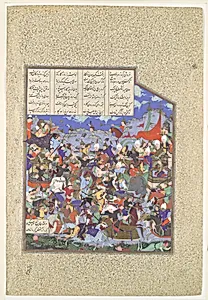
"The Battle of Pashan Begins", Folio 243v from the Shahnama (Book of Kings) of Shah Tahmasp
ca. 1530–35
Medium
Opaque watercolor, ink, silver, and gold on paper
Dimensions
Painting: H. 10 3/4 in. (27.3 cm) W. 9 5/8 in. (24.4 cm) Page: H. 18 11/16 in. (47.5 cm) W. 12 5/8 in. (32.1 cm) Mat: H. 22 in. (55.9 cm) W. 16 in. (40.6 cm)
Classification
Codices
Department
Islamic Art
Museum
Metropolitan Museum of Art, New York, NY
Credit
Gift of Arthur A. Houghton Jr., 1970
Accession Number
1970.301.37
Rights
Public Domain
Tags
Art Historical Context
This vibrant folio, "The Battle Pashan Begins"Folio 243v), from the magnificent *Shahnama* (Book of Kings) of Shah Tahmasp, crowning achievement of Safavid Persian manuscript art. Created around 1530–35 in the royal atelier of Tabriz, this epic poem by the 11th-century poet Abu'l Qasim Firusi recounts the mythical history of Persian kings and heroes. Illustrated by the skilled artist 'Abd al-Vhab, it captures a chaotic clash of warriors on horseback, embodying the timeless drama of good versus evil in Iran's national epic. The *Shahnama* of Shah Tahmasp, commissioned by the Safavid ruler (r. 1524–76), represents the pinnacle of Islamic miniature painting, blending poetry and visuals to glorify Persian heritage during a golden age of Shia patronage. Measuring about 10¾ by 9⅝ inches, the painting employs opaque watercolor, ink, silver, and gold on paper—techniques that create luminous depth, intricate patterns on armor and horse trappings, and a dynamic composition of charging figures amid swirling dust. Housed in the Metropolitan Museum of Art's Islamic Art Department (gift of Arthur A. Houghton Jr., 1970), this folio highlights the cultural prestige of battle scenes in Persian art, where stylized violence underscores heroic valor. Visitors will appreciate its exquisite detail, a testament to the collaborative genius of poets, calligraphers, and painters in 16th-century Iran.
About the Artist
'Abd al-Vahhab|Abu'l Qasim Firdausi (Iranian|Iranian) · |0935 – |1020
Iranian|Iranian, Paj ca. 940/41–1020 Tus