
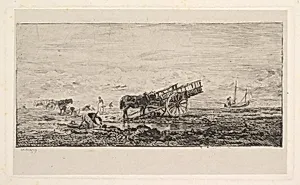
The Beach at Villerville
1837–78
Medium
Etching; third state of five (Delteil)
Dimensions
Image: 3 5/8 × 8 7/8 in. (9.2 × 22.5 cm) Plate: 5 in. × 8 1/2 in. (12.7 × 21.6 cm) Sheet: 17 5/8 × 12 3/8 in. (44.8 × 31.4 cm)
Classification
Prints
Department
Drawings and Prints
Museum
Metropolitan Museum of Art, New York, NY
Credit
Rogers Fund, 1920
Accession Number
20.29.5
Rights
Public Domain
Tags
Art Historical Context
**The Beach at Villerville is a delicate etching by Charles-François Daigny, a leading French landscape artist of the 19th century and a key figure in the Barbizon School. Created between 1837 and 1878—this print represents the third state of five as catalogued by Loys Delteil—it captures a serene coastal scene at Villerville a Normandy beach popular among artists. Daubigny, known for his poetic depictions of nature, here renders horses pulling carts, beached boats, and the vast shoreline with masterful line work, evoking the everyday rhythm of seaside life. As an etching, the medium allowed Daubigny to achieve subtle tonal variations through aquatint-like effects and multiple states, refining details like the texture of waves and sand. This print exemplifies his innovative approach to printmaking, bridging traditional techniques with the emerging Realism that influenced Impressionism. Measuring just 3⅝ × 8⅞ inches, its intimate scale invites close viewing, revealing the artist's keen observation of light and atmosphere. Acquired through the Rogers Fund in 1920, this work from the Metropolitan Museum of Art's Drawings and Prints collection highlights Daubigny's enduring legacy in celebrating humble, natural motifs. Visitors will appreciate how it transports us to 19th-century France, where the beach was both a playground and a profound source of inspiration.
About the Artist
Charles-François Daubigny · 1817–1878
Charles-François Daubigny was born on February 15, 1817, in Paris into a family of artists, with his father, Edmé-François Daubigny, a classical landscape painter, and his uncle, Pierre Daubigny, a miniaturist, providing his initial artistic training. He further studied under Jean-Victor Bertin, Jacques Raymond Brascassat, and Paul Delaroche at the École des Beaux-Arts, though he quickly moved bey...