
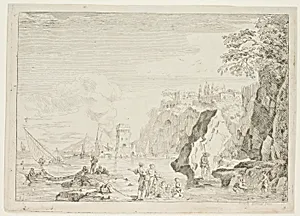
The Beach with the Large Tower
1734/52
Medium
Etching in black on ivory laid paper
Dimensions
Image: 20.1 × 29 cm (7 15/16 × 11 7/16 in.); Plate: 21.9 × 30.4 cm (8 5/8 × 12 in.); Sheet: 22.2 × 31 cm (8 3/4 × 12 1/4 in.)
Classification
etching
Department
Prints and Drawings
Museum
Art Institute of Chicago
Accession Number
215733
Rights
Public Domain
Art Historical Context
Claude Joseph Vernet’s “The Beach with the Large Tower” captures the quiet drama of a coastal scene through the delicate lines of an etching. Created sometime between 1734 and 1752, the print reflects Vernet’s deep interest marine subjects, a specialty that earned him recognition across Europe. Working in black ink on ivory laid paper, he used the etching process to build subtle gradations of light and shadow, evoking the atmosphere of a windswept shore. Vernet spent nearly two decades in Italy during this period, absorbing the classical landscape tradition while observing real harbors and coastlines. Etchings like this one allowed his compositions to reach a wider audience than paintings alone, circulating among collectors and connoisseurs who admired the refined balance between natural detail and composed serenity. The prominent tower serves as both a visual anchor and a reminder of human presence within the vastness of sea and sky. Today the print resides in the Art Institute of Chicago’s collection of works on paper, where its modest size—roughly eight by twelve inches—invites close looking. Viewers can appreciate how the medium’s crisp lines translate Vernet’s painterly vision into an intimate, reproducible form that still feels fresh centuries later.
About the Artist
Claude Joseph Vernet · 1714–1789
Claude-Joseph Vernet and his direct descendants are the last representatives of the Avignon School which had provided a continuous line of artists since the 14th century. It originated at the time when Bernard de Goth, Archbishop of Bordeaux, became pope in the name of Clement V and transferred the seat of the papacy to Avignon where he established an influential artistic community. Comment on wor...