
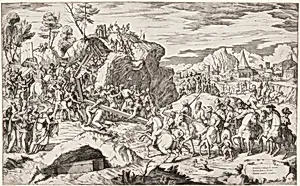
The Bearing of the Cross
Medium
etching and engraving on two joined sheets of laid paper
Dimensions
sheet: 40.6 × 65.3 cm (16 × 25 11/16 in.), trimmed within platemark
Classification
Department
CG-E
Museum
National Gallery of Art, Washington, D.C.
Credit
Ruth and Jacob Kainen Memorial Acquisition Fund
Accession Number
2020.124.1
Rights
Public Domain
Art Historical Context
Visitors to the National Gallery of Art are invited to contemplate *The Bearing of the Cross a striking 16th-century print Giovanni Battista Fontana, created after a design by Domenico Campagn around 1569–1573. This poignant depiction draws from the Passion of Christ, capturing the solemn moment when Jesus bears the cross to Calvary amid a crowd of figures—soldiers, mourners, disciples—evoking deep religious emotion. Rooted in the Venetian Renaissance tradition, Campagnola's influence from Titian shines through in the dramatic composition, while Fontana's execution reflects the era's mastery of printmaking as a means to disseminate sacred narratives widely. Crafted through etching and engraving on two joined sheets of laid paper, the work measures an impressive 40.6 × 65.3 cm, allowing for a panoramic vista that immerses viewers in the scene. Etching provided fluid, tonal depths for shadows and textures, while engraving added precise lines for intricate details like flowing drapery and expressive faces—a technical harmony that elevated prints from mere reproductions to standalone artworks. Acquired through the Ruth and Jacob Kainen Memorial Acquisition Fund, this print exemplifies the Counter-Reformation's emphasis on vivid religious imagery, bridging elite painting traditions with accessible devotion. Its large scale and mixed techniques highlight the innovative spirit of Italian printmakers, making profound biblical stories tangible for generations.