
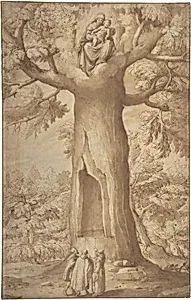
The Beech Tree of the Madonna at La Verna
1605–7
Medium
Pen and brown ink, brush and brown wash and with traces of gray wash, over black chalk
Dimensions
15-13/16 x 10-1/8 in. (40.2 x 25.7 cm)
Classification
Drawings
Department
Drawings and Prints
Museum
Metropolitan Museum of Art, New York, NY
Credit
Harry G. Sperling Fund, 1983
Accession Number
1983.131.1
Rights
Public Domain
Tags
Art Historical Context
In the serene world of early 17th-century Italian drawing, Jacopo Lig captures the sacred landscape of La Verna in *The Beech Tree of the Madonna created between 1605 and 1607. This intricate pen and brown ink work, heightened with brush and brown wash black chalk (15-13/16 x 10-1/8 in.), depicts a majestic beech tree revered at the Franciscan sanctuary of La Verna in Tuscany—site of St. Francis's stigmata miracle. Amid its twisting branches, the Madonna and Child appear in a visionary apparition, accompanied by figures of men, blending natural wonder with divine presence. Ligozzi, a Florentine Mannerist artist famed for his precise natural history studies, infuses the scene with meticulous botanical detail, elevating the tree to a symbol of spiritual refuge. His technique—layered ink lines for texture, subtle washes for depth, and faint gray accents for modeling—showcases the era's mastery of mixed media on paper, often prized as independent works rather than mere sketches. Housed in the Metropolitan Museum of Art's Drawings and Prints department (acquired via the Harry G. Sperling Fund in 1983), this piece highlights the Counter-Reformation's emphasis on evocative religious imagery, inviting pilgrims and viewers alike to contemplate nature's role in faith. A testament to Ligozzi's skill, it bridges science and sanctity in a single, luminous sheet.
About the Artist
Jacopo Ligozzi · 1547–1627
Comment on works: Religious; History