
The Beheading of Saint John the Baptist
Unknown Artist
mid-16th century
Medium
Honestone, partially gilt
Dimensions
Height: 11 3/4 in. (29.8 cm)
Classification
Sculpture-Miniature
Culture
German, possibly Rhenish
Department
European Sculpture and Decorative Arts
Museum
Metropolitan Museum of Art, New York, NY
Credit
Gift of J. Pierpont Morgan, 1917
Accession Number
17.190.742
Rights
Public Domain
Tags
Art Historical Context
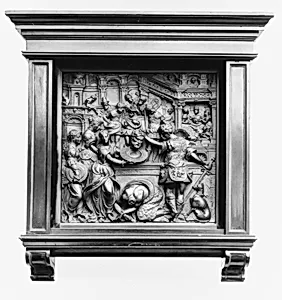
Nestled in the Metropolitan Museum of Art's European Sculpture and Decorative collection, *The Beheading of Saint the Baptist* is a mid-16th-century sculpture attributed to an unknown German artist, possibly from the Rhenish. Carved from honestone—a fine-grained, soapstone-like material prized for its smooth carvability—and partially gilded for a luxurious sheen, this 11-inch (29.8 cm) high piece captures the dramatic biblical scene with exquisite detail. Gifted by J. Pierpont Morgan 1917, it the intricate craftsmanship of Renaissance-era devotional art. The sculpture depicts the martyrdom of Saint John the Baptist, with Salome receiving his head, surrounded by men, women, and even dogs—likely symbolizing fidelity or the executioner's hounds in a vivid narrative tableau. Honestone's softness allowed the artist to render delicate features, flowing drapery, and expressive gestures, while selective gilding highlights key elements like halos or jewelry, enhancing its spiritual glow. In 16th-century Germany, such small-scale works were treasured for private altars or collectors' cabinets, blending piety with artistic virtuosity amid the Reformation's religious fervor. This rare miniature invites visitors to marvel at its storytelling power, frozen in stone yet alive with emotion, reflecting the Rhineland's tradition of masterful stone carving during a transformative era in European art.