
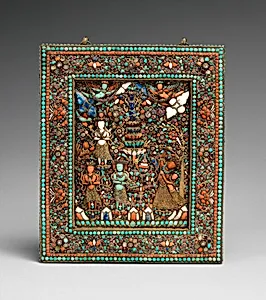
The Birth of the Buddha
Unknown Artist
18th–19th century
Medium
Mosaic set in a gilt-silver framework with diamonds, rubies, emeralds, sapphires, garnets, quartz, pearls, amber, coral, lapis lazuli, turquoise, and semiprecious stones
Dimensions
14 1/2 x 12 1/4 in. (36.8 x 31.1 cm)
Classification
Metalwork
Culture
Nepal
Department
Asian Art
Museum
Metropolitan Museum of Art, New York, NY
Credit
John Stewart Kennedy Fund, 1915
Accession Number
15.95.163
Rights
Public Domain
Tags
Art Historical Context
Nestled in the Metropolitan Museum of Art's Asian Art collection, *The Birth of the Buddha is a stunning 18th–19th-century Nepalese masterpiece by an unknown artist. This small yet opulent mosaic (14½ × 12¼ in.) captures the miraculous birth of Siddharthaama, the future Buddha, a pivotal moment in Buddhist cosmology. Typically depicted as Queen Maya giving birth painlessly under a sal tree—with deities like Brahma in attendance—the scene symbolizes purity, enlightenment, and divine, resonating deeply in Himalayan Buddhist traditions. Crafted as a mosaic set within a gilt-silver framework, the artwork dazzles with meticulously cut fragments of diamonds, rubies, emeralds, sapphires, garnets, quartz, pearls, amber, coral, lapis lazuli, turquoise, and other semiprecious stones. This micromosaic technique, akin to pietra dura, reflects the virtuoso metalworking skills of Nepal's Newar artisans from the Kathmandu Valley. The lavish materials not only create vibrant, enduring color but also signify profound devotion and royal patronage, as such jeweled objects adorned temple shrines. In Nepalese culture, where Buddhism and Hinduism intertwine, this piece exemplifies the era's fusion of Indian iconography with Tibetan influences. Acquired through the John Stewart Kennedy Fund in 1915, it invites visitors to marvel at how tangible luxury embodies spiritual narratives, bridging the earthly and the divine.