
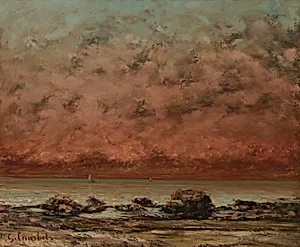
The Black Rocks at Trouville
1865/1866
Medium
oil on canvas
Dimensions
overall: 50 × 61 cm (19 11/16 × 24 in.) framed: 70.8 × 81.28 × 6.35 cm (27 7/8 × 32 × 2 1/2 in.)
Classification
Painting
Department
CF
Museum
National Gallery of Art, Washington, D.C.
Credit
Chester Dale Fund
Accession Number
2011.51.1
Rights
Public Domain
Art Historical Context
### The Black Rocks at Trouville Step into the rugged embrace of the Normandy coast with Gustave Courbet's *The Black Rocks at Trou* (1865/1866), a captivating oil on canvas that exemplifies the artist's mastery of Realism. Painted during Courbet's stay in the fashionable seaside town of Trouville, work captures the dramatic interplay of jagged black rocks against crashing waves, reflecting mid-19th-century France's growing fascination with unvarnished nature. As a leader of the Realist movement, Courbet rejected Romantic idealization, instead portraying the raw power of the sea with earthy tones and bold, textured brushwork that invites viewers to feel the salt spray and hear the roar of the surf. At 50 × 61 cm, this intimate yet immersive painting showcases oil on canvas's versatility for conveying light and atmosphere. Courbet's loose, impasto strokes build depth and movement, emphasizing the tactile quality of the rocks and water—techniques that influenced later Impressionists. Acquired through the Chester Dale Fund for the National Gallery of Art, it stands as a testament to Courbet's innovative approach to landscape, blending personal observation with a profound respect for the everyday sublime. This piece not only highlights Trouville's allure as a retreat for artists like Courbet but also underscores Realism's cultural shift toward celebrating ordinary beauty over heroic myths. A perfect gem for contemplating nature's untamed force! (198 words)
About the Artist
Gustave Courbet · 1819–1877
Jean Désiré Gustave Courbet (1819-1877) was a French painter who revolutionized 19th-century art as the founding figure of the Realism movement. Born in Ornans, a small town in the Doubs region of France, Courbet came from a prosperous farming family with anti-monarchical roots—his maternal grandfather had participated in the French Revolution. This background shaped his lifelong commitment to dep...