
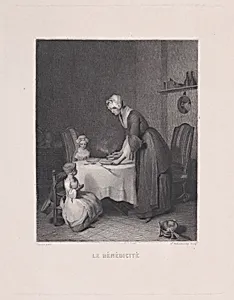
The Blessing
19th century
Medium
Etching
Dimensions
Sheet: 12 5/8 × 9 5/8 in. (32 × 24.5 cm) Plate: 8 9/16 × 6 5/8 in. (21.7 × 16.9 cm)
Classification
Prints
Department
Drawings and Prints
Museum
Metropolitan Museum of Art, New York, NY
Credit
Gift of Georgiana W. Sargent, in memory of John Osborne Sargent, 1924
Accession Number
24.63.1305
Rights
Public Domain
Tags
Art Historical Context
Jean Siméon Chardin, a master of 18th-century French genre painting, captures the tender intimacy of daily life in *The Blessing*, an etching reproduced in the 19th century by Ed. Budischowsky. print depicts a serene domestic moment—likely a young child offering grace before a meal, surrounded by a woman in a humble dining setting. Chardin's originals, painted during the Rococo era, celebrated ordinary scenes with remarkable realism and warmth, elevating the everyday to poetic heights. Etching, as seen here in the precisely measured plate (8 9/16 × 6 5/8 in.), was a key reproductive technique that allowed Chardin's subtle textures—soft fabrics, gleaming tableware, and gentle expressions—to reach wider audiences long after his death in 1779. Budischowsky's edition preserves the artist's delicate line work and tonal gradations, hallmarks of Chardin's influence on later realists like the Impressionists. Housed in the Metropolitan Museum of Art's Drawings and Prints department (gift of Georgiana W. Sargent, 1924), this 19th-century sheet (12 5/8 × 9 5/8 in.) reflects enduring cultural reverence for family rituals and childhood innocence, reminding us of Chardin's genius in finding beauty in the commonplace.
About the Artist
Jean Siméon Chardin|Ed. Budischowsky · 1699–1779
Jean-Baptiste-Siméon Chardin, born on November 2, 1699, in Paris to a cabinetmaker father who crafted billiard tables, grew up immersed in the city's artisan world on the Left Bank near Saint-Sulpice. His early training came through apprenticeships with the history painters Pierre-Jacques Cazes, where he honed academic drawing techniques, and Noël-Nicolas Coypel, whose assignment to copy a musket ...