
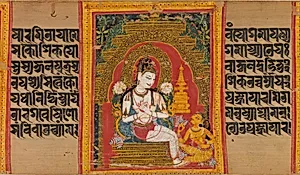
The Bodhisattva Avalokitesvara Expounding the Dharma to a Devotee: Folio from a Ashtasahasrika Prajnaparamita Sutra Manuscript
early 12th century
Medium
Opaque watercolor on palm leaf
Dimensions
Page: 2 3/4 x 16 7/16 in. (7 x 41.8 cm) Image: 2 1/2 x 1 15/16 in. (6.4 x 4.9 cm)
Classification
Paintings
Culture & Period
India, West Bengal or Bangladesh · Pala period
Department
Asian Art
Museum
Metropolitan Museum of Art, New York, NY
Credit
Purchase, Lila Acheson Wallace Gift, 2001
Accession Number
2001.445f
Rights
Public Domain
Tags
Art Historical Context
This exquisite folio, titled *The Bodhisattva Avalokitesvara Expounding the Dharma to a Devotee*, comes from an *Ashtasahasrika Prajnaparamita Sutra* manuscript, a foundational Mahayana Buddhist text extolling the "Perfection of Wisdom." Created by the Mahavihara Master in early 12th-century eastern India during the Pala period (8th–12th centuries), it captures Avalokitesvara—the bodhisattva of infinite compassion—teaching a devoted disciple. Produced in the monastic workshops of West Bengal or Bangladesh, such manuscripts were sacred objects, blending scripture with vivid illustrations to inspire devotion and contemplation. Painted in opaque watercolor on a slender palm leaf—a traditional South Asian medium prized for its durability and portability—the tiny image (just 2½ x 1⅞ inches) exemplifies Pala artistry's precision and elegance. Artists layered brilliant mineral pigments for luminous effects, rendering serene figures with elongated bodies, graceful gestures, and intricate jewelry against stylized architectural backdrops. These folios, often bound with wooden covers, were chanted in rituals, making art a bridge between the divine and the everyday. Housed in the Metropolitan Museum of Art's Asian Art Department, this piece highlights the Pala dynasty's golden age of Buddhist patronage, just before the tradition's decline. It invites visitors to marvel at how miniature masterpieces preserved profound teachings across centuries.