
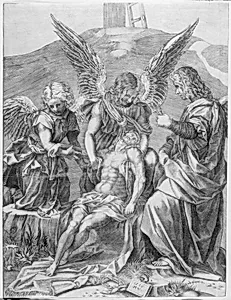
The Body of Christ Supported by Three Angels
Medium
Engraving
Dimensions
sheet: 11 5/16 x 8 5/8 in. (28.8 x 21.9 cm)
Classification
Prints
Department
Drawings and Prints
Museum
Metropolitan Museum of Art, New York, NY
Credit
The Elisha Whittelsey Collection, The Elisha Whittelsey Fund, 1949
Accession Number
49.97.13
Rights
Public Domain
Tags
Art Historical Context
In the heart of the High Renaissance, *The Body of Christ Supported Three Angels* (1516) captures a poignant moment of divine sorrow. Created as an engraving by Agostinoiano (Agostino Musi), it reproduces a design by the Florentine master Andrea del Sarto (Andrea d'Agnolo), whose graceful figures and emotional depth defined the era's artistic elegance. This collaboration exemplifies how printmakers like Veneziano popularized painters' compositions, making sacred imagery accessible beyond elite patrons. The scene depicts Christ's limp body tenderly upheld by three angels, evoking the Pietà tradition—a staple of Christian iconography symbolizing mourning and redemption. Veneziano's engraving technique, incising fine lines into a copper plate for inking and printing, allowed for intricate details in the angels' flowing drapery and expressive faces, rendered on a modest sheet of 11 5/16 x 8 5/8 inches. Such prints were revolutionary, bridging workshops and devout audiences across Europe. Housed in the Metropolitan Museum of Art's Drawings and Prints department (Elisha Whittelsey Collection, 1949), this work highlights the Renaissance fusion of innovation and faith, inviting viewers to ponder humanity's spiritual core through masterful lines.