
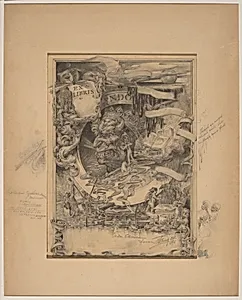
The Bookplate of the Printer's Devil
Medium
graphite on wove paper
Dimensions
sheet: 30.2 x 24.5 cm (11 7/8 x 9 5/8 in.) with mat: 40.7 x 32.5 cm (16 x 12 13/16 in.)
Classification
Drawing
Department
CG-W
Museum
National Gallery of Art, Washington, D.C.
Credit
Ailsa Mellon Bruce Fund
Accession Number
2008.1.5
Rights
Public Domain
Art Historical Context
Welcome to the National Gallery of Art, where we spotlight *The Bookplate of the Printer's Devil*, a delicate 1895 drawing by American artist Francis Scott King. in graphite on wove paper—a smooth, versatile surface ideal for intricate line work and subtle shading—this sheet measures 30.2 x 24.5 cm. Acquired through the Ailsa Mellon Fund, it exemplifies the refined draftsmanship of the late 19th centuryBookplates, or ex-libris, were labels pasted inside books to denote ownership, blending personal heraldry with artistic flair. King's design evokes the whimsical world of printing trades, with "Printer's Devil" nodding to the apprentice who inked presses and ran errands in old print shops—a nod to the era's fascination with craftsmanship amid the rise of industrial publishing. This preparatory drawing likely served as a study for engraving or printing, highlighting the meticulous preparatory techniques of illustrators. In the context of Gilded Age America, such works reflect a cultural reverence for books as treasures, bridging fine art and everyday utility. King's graphite mastery captures texture and narrative in a compact form, inviting us to appreciate the hidden artistry behind the printed page. A charming glimpse into bibliographic history!
About the Artist
Francis Scott King · 1850–1913
**Francis Scott King (1850–1913) was an American engraver, printmaker, and painter known for his intricate bookplates and wood engravings, as well as works in oil depicting figures, genre scenes, and still lifes.** Born in Auburn, Maine, he spent much of his career working in New York before his death in Newark, New Jersey. King specialized in detailed printmaking techniques, producing finely cra...