
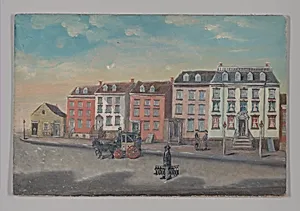
The Boot Black
1870s
Medium
Oil on slate paper
Dimensions
6 1/16 x 9 1/8 in. (15.4 x 23.2 cm)
Classification
Painting
Culture
American
Department
The American Wing
Museum
Metropolitan Museum of Art, New York, NY
Credit
The Edward W. C. Arnold Collection of New York Prints, Maps, and Pictures, Bequest of Edward W. C. Arnold, 1954
Accession Number
54.90.501
Rights
Public Domain
Tags
Art Historical Context
William P. Chappel's *The Boot Black* (1870s) offers a charming glimpse into everyday urban life in nineteenth-century America. Painted in oil on slate paper, this small work—measuring just over six by nine inches—depicts a street scene populated by men, carriages, and modest houses. The central figure is likely a bootblack, one of the many young workers who provided shoe-shining services on city sidewalks, capturing the hustle of post-Civil War street commerce. The unusual choice of slate paper as a support gives the painting a distinctive, matte surface that enhances its intimate scale, inviting close viewing much like a print or drawing. As part of the Metropolitan Museum’s American Wing, the work belongs to the Edward W. C. Arnold Collection, which preserves vivid records of New York’s changing cityscape through paintings, prints, and maps. Chappel’s focus on ordinary laborers and bustling thoroughfares reflects a broader artistic interest in genre scenes that documented the social fabric of growing American cities. Today, the painting serves as a valuable historical document, preserving the textures of 1870s street life for modern audiences.
About the Artist
William P. Chappel · 1801–1878
American, 1801–1878