
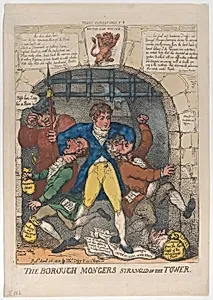
The Borough Mongers Strangled in the Tower
Medium
Hand-colored etching
Dimensions
Plate: 13 9/16 × 9 13/16 in. (34.4 × 24.9 cm) Sheet: 14 3/4 × 10 1/4 in. (37.4 × 26.1 cm)
Classification
Prints
Department
Drawings and Prints
Museum
Metropolitan Museum of Art, New York, NY
Credit
The Elisha Whittelsey Collection, The Elisha Whittelsey Fund and Harris Brisbane Dick Fund, by Exchange, 1970
Accession Number
1970.541.32
Rights
Public Domain
Tags
Art Historical Context
This hand-colored etching from April 1810 captures the sharp political satire of Georgian Britain. Created by Thomas Rowlandson, a leading caricaturist of his day, the print uses exaggerated figures and witty visual commentary to lampoon the “borough mongers”—wealthy elites who controlled rotten boroughs and dominated Parliament. Its title references the Tower of London, evoking the imprisonment of reformer Sir Francis Burdett, who had challenged parliamentary privilege earlier that year. Rowlandson’s lively line work and vibrant hand-coloring made such prints both affordable and visually striking, allowing them to reach a wide audience through publishers like Thomas Tegg. As a medium, the etching was ideal for timely political commentary, blending humor with pointed critique of corruption and reform debates that shaped early nineteenth-century Britain. Today, the work offers a vivid window into the era’s turbulent politics and the power of caricature to influence public opinion. Its presence in the Metropolitan Museum’s collection highlights how prints like this served as both art and social documents, preserving the spirited debates of their time for modern viewers.
About the Artist
Thomas Rowlandson|Sir Francis Burdett, 5th Baronet|Thomas Tegg · 1756–1827
Thomas Rowlandson (1757–1827) was an English artist and caricaturist whose satirical watercolors and prints captured the social life of Georgian Britain with unparalleled wit and technical mastery. Alongside James Gillray, he is recognized as one of the greatest British graphic artists, and his distinctive flowing line and keen observations have made his work integral to understanding late 18th an...