
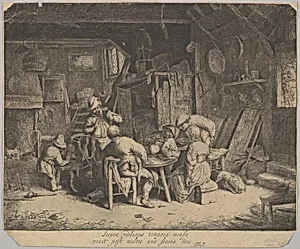
The Breakfast (Le Gourmet en Compagne)
17th century
Medium
Etching; twelfth state
Dimensions
Sheet: 8 1/2 × 10 3/16 in. (21.6 × 25.9 cm)
Classification
Prints
Department
Drawings and Prints
Museum
Metropolitan Museum of Art, New York, NY
Credit
Bequest of Julia H. Manges, in memory of her husband, Dr. Morris Manges, 1960
Accession Number
60.598.121
Rights
Public Domain
Tags
Art Historical Context
In the heart of the Dutch Golden Age, Adriaen van Ostade the simple joys of rural life in *The Breakfast (Le Gourmet Compagne)*, a 17th-century etching from twelfth state. This lively genre scene likely depicts a modest family gathering—men, women, and children—sharing a countryside meal, reflecting van Ostade's signature of portraying peasants with humor, warmth, and keen observation. As a master of everyday vignettes, he drew from the vibrant peasant traditions of his native Haarlem, elevating ordinary moments into timeless commentary on human connection. Etching, van Ostade's preferred medium here, allowed for intricate lines and tonal depth on a compact sheet (8 1/2 × 10 3/16 in.), making prints accessible to a wider audience beyond oil paintings. The twelfth state represents a refined stage in the plate's evolution, with added details enhancing texture and narrative—think crinkled clothing, expressive faces, and rustic tableware. This technique democratized art during a booming print market fueled by Rembrandt's influence. Housed in the Metropolitan Museum of Art's Drawings and Prints department (Bequest of Julia H. Manges, 1960), the work embodies the cultural shift toward celebrating the "lowly" folk, offering museum visitors a window into 17th-century Dutch life where breakfast wasn't just sustenance, but a feast of camaraderie.
About the Artist
Adriaen van Ostade · 1610–1685
Adriaen Jansz. van Ostade (1610-1685) was a Dutch Baroque painter and printmaker who specialized in genre scenes of peasant life. Born and raised in Haarlem, he became one of the most prolific and celebrated artists of the Dutch Golden Age, producing over 800 paintings, 50 etchings, and numerous drawings. Van Ostade's significance in art history lies in his masterful depiction of peasant life, a ...