
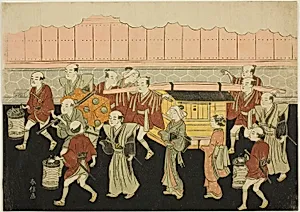
The Bride Riding in the Palanquin to Her Husband's House (Koshi-iri), the third sheet of the series "Marriage in Brocade Prints, the Carriage of the Virtuous Woman (Konrei nishiki misao-guruma)"
c. 1769
Medium
Color woodblock print; chuban yoko-e
Dimensions
20.1 × 28 cm (7 7/8 × 11 in.)
Classification
woodblock print
Department
Arts of Asia
Museum
Art Institute of Chicago
Accession Number
21134
Rights
Public Domain
Art Historical Context
Suzuki Harunobu's *The Bride Riding in the Palanquin to Her Husband's House (Koshi-)*, created around 1769, captures a poignant moment in a traditional Japanese wedding procession. As the third sheet in the series *Marriage in Brocade Prints, the Carriage of the Virtuous Woman (Kon nishiki misao-guruma)*, it the bride being carried in a lacquered palanquin—known as a *koshi*—to her new home, surrounded by attendants in vibrant kimonos. This intimate scene reflects Edo-period (1603–1868) customs, where such processions symbolized the bride's transition to virtuous wifehood amid community celebration. Harunobu, a master of ukiyo-e ("pictures of the floating world"), pioneered full-color woodblock prints, or *nishiki-e* ("brocade pictures"), in the 1760s. Printed in the chuban yoko-e format (a compact horizontal half-sheet, 20.1 × 28 cm), this work showcases his innovative use of multiple woodblocks for layered colors, achieving a luxurious, tapestry-like glow. His focus on graceful women and everyday rituals elevated genre scenes to high art. Housed in the Art Institute of Chicago's Arts of Asia collection, this print offers a window into 18th-century social norms, blending beauty, ceremony, and subtle emotion to immortalize a fleeting cultural rite.
About the Artist
Suzuki Harunobu · 1725–1770
Suzuki Harunobu (c. 1725-1770) was a Japanese ukiyo-e artist who revolutionized woodblock printing by developing nishiki-e—full-color prints using multiple woodblocks—in 1765. Before Harunobu, Japanese prints were limited to two or three colors; his innovation unleashed the entire artist's palette, transforming ukiyo-e into the vibrant art form that would later captivate Western artists from Manet...