
The Bridge (Le pont)
1897/1898 (published 1899)
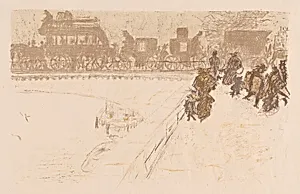
Medium
3-color lithograph on wove paper
Dimensions
image: 27 x 40.8 cm (10 5/8 x 16 1/16 in.) sheet: 40.8 x 52.7 cm (16 1/16 x 20 3/4 in.)
Classification
Department
CG-E
Museum
National Gallery of Art, Washington, D.C.
Credit
Virginia and Ira Jackson Collection
Accession Number
2000.180.13
Rights
Public Domain
Art Historical Context
Pierre Bonnard's *The Bridge (Le pont)*, created around 1897–1898 and published in 1899, captures the artist's early mastery of printmaking during a vibrant period in French art. As a key member of Les Nabis—an avant-garde group influenced by Paul Gauguin and Japanese woodblocks—Bonnard emphasized bold colors, decorative patterns, and intimate scenes over realistic representation. This work reflects the late 19th-century explosion of color lithography in Paris, where posters by artists like Toulouse-Lautrec transformed urban streets into galleries, making art accessible to the masses. Printed as a three-color lithograph on smooth wove paper, *The Bridge* showcases Bonnard's innovative technique. Lithography allowed him to layer vibrant hues directly from stones, achieving a luminous, painterly quality rare in prints at the time. Measuring 27 x 40.8 cm, its intimate scale invites close viewing, revealing the Nabis' focus on surface pattern and emotional resonance over narrative depth. Housed in the National Gallery of Art's Virginia and Ira Jackson Collection, this print exemplifies Bonnard's bridge between fine art and popular media, influencing modern graphic design. Visitors will appreciate its joyful evocation of everyday French life, frozen in enduring color.
About the Artist
Pierre Bonnard · 1867–1947
Pierre Bonnard (1867–1947) was a French painter and printmaker who became a leading figure in the Post-Impressionist movement and a founding member of Les Nabis. Born on October 3, 1867, in Fontenay-aux-Roses, France, Bonnard initially studied law at his father's insistence, graduating and briefly practicing as a barrister in 1888. However, his true passion lay in art, and he had simultaneously at...