
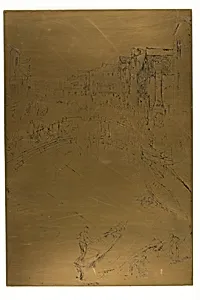
The Bridge, Santa Marta
1879/80
Medium
Cancelled copper plate
Dimensions
29.8 × 20.1 cm (11 3/4 × 7 15/16 in.)
Classification
copper plate
Department
Prints and Drawings
Museum
Art Institute of Chicago
Accession Number
180941
Rights
Public Domain
Art Historical Context
James McNeill Whistler created this copper plate for "The Bridge, Santa Marta" during his pivotal stay in Venice from 1879 to 1880. Following financial difficulties in London, the artist turned to printmaking, producing a celebrated series of etchings that captured the city's quiet canals and architectural details with remarkable sensitivity. The work reflects Whistler's mature style, emphasizing atmosphere and subtle tonal effects over precise realism. As a cancelled copper plate rather than a finished print, this object offers a rare glimpse into the artist's working process. Whistler incised the design into the metal surface, which would have been used to produce impressions on paper, before deliberately scoring lines across it to prevent further editions. Measuring just under 12 inches tall, the plate highlights his technical mastery of etching, a medium he elevated to fine art status through innovative use of line and suggestion. Housed in the Art Institute of Chicago's Prints and Drawings collection, this piece underscores the enduring value of Whistler's Venetian output. Cancelled plates like this one serve as both historical documents and artistic statements, preserving evidence of his creative decisions at a transformative moment in his career.
About the Artist
James McNeill Whistler · 1834–1903
James Abbott McNeill Whistler (1834-1903) was an American-born painter and printmaker who became a leading figure in the Aesthetic Movement and pioneer of Tonalism and Japonisme. He revolutionized art by championing "art for art's sake" and treating paintings as visual equivalents of musical compositions, titling works as "arrangements," "harmonies," and "nocturnes" to emphasize formal qualities o...