
The Broken Oar
Medium
Pen and ink on tracing paper
Dimensions
Sheet: 5 3/16 × 7 1/4 in. (13.1 × 18.4 cm)
Classification
Drawings
Department
Drawings and Prints
Museum
Metropolitan Museum of Art, New York, NY
Credit
Purchase, The Elisha Whittelsey Collection, The Elisha Whittelsey Fund and PECO Foundation Gift, 2018
Accession Number
2018.11.20
Rights
Public Domain
Tags
Art Historical Context
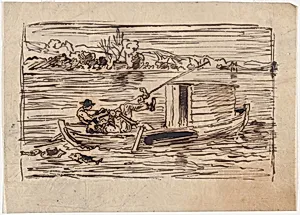
Charles-François Daubigny, leading figure in the Barbizon school landscape painting, created *The Broken Oar* in 1862. This intimate drawing captures the artist's lifelong fascination with river life along the Seine and Oise, where he often painted en plein air from his studio boat, *Le Botin*. As a precursor to Impressionism, Daigny's work emphasized natural light, atmospheric effects, and unidealized nature, bridging Romanticism and modernity during a time of rapid industrialization in France. Rendered in pen and ink on tracing paper—a lightweight, translucent medium ideal for preparatory sketches and transfers—this 5 3/16 × 7 1/4-inch study likely served as a quick notation from life. The broken oar, a humble boating motif, evokes the everyday rhythms of rural waterways, showcasing Daubigny's precise linework and economical technique. Such drawings reveal the spontaneity behind his larger oil paintings, highlighting his role in elevating sketches to artistic ends. Acquired by the Metropolitan Museum of Art in 2018 through the Elisha Whittelsey Collection, *The Broken Oar* offers visitors a glimpse into 19th-century plein-air practice, reminding us how fleeting observations fueled enduring masterpieces.
About the Artist
Charles-François Daubigny · 1817–1878
Charles-François Daubigny was born on February 15, 1817, in Paris into a family of artists, with his father, Edmé-François Daubigny, a classical landscape painter, and his uncle, Pierre Daubigny, a miniaturist, providing his initial artistic training. He further studied under Jean-Victor Bertin, Jacques Raymond Brascassat, and Paul Delaroche at the École des Beaux-Arts, though he quickly moved bey...