
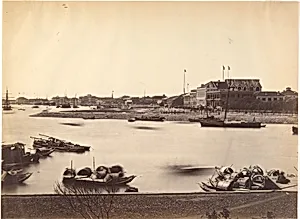
The Bund in Shanghai
ca. 1869
Medium
Albumen silver print from glass negative
Dimensions
Image: 9 9/16 × 13 1/16 in. (24.3 × 33.2 cm)
Classification
Photographs
Department
Photographs
Museum
Metropolitan Museum of Art, New York, NY
Credit
Gilman Collection, Purchase, Robert Rosenkranz Gift, 2005
Accession Number
2005.100.494.105
Rights
Public Domain
Tags
Art Historical Context
In the mid-19th century,'s Bund emerged as a vibrant symbol of the city's transformation into a bustling treaty port, blending Eastern and Western influences along the Huangpu River. John Thomson *The Bund in Shanghai* (ca. 1869) captures this dynamic scene through an albumen silver print a glass negative, showcasing a lively waterfront lined with grand buildings, boats dotting the river, and hum of international trade. The photograph's expansive composition—measuring 9 9/16 × 13 1/16 inches—invites viewers to immerse themselves in the era's energy, where junks and steamers coexisted amid colonial architecture. Thomson's pioneering work exemplifies early photographic documentation of Asia, using the albumen process for its rich detail and subtle tonalities, which preserved fleeting moments with remarkable clarity. Developed from wet-collodion glass negatives, this medium was a hallmark of 19th-century photography, allowing for portable fieldwork in remote locations. As part of the Gilman Collection at The Metropolitan Museum of Art, this print offers a window into Shanghai's role as a gateway between East and West during the late Qing dynasty, highlighting the cultural and economic shifts of the time.
About the Artist
John Thomson · 1837–1921
John Thomson (1837–1921), a pioneering Scottish photographer, was born on 14 June 1837 in Edinburgh as the eighth of nine children to William Thomson, a tobacco spinner and trader, and Isabella Newlands.) After schooling in the early 1850s, he apprenticed with a local optical and scientific instrument manufacturer, where he mastered the principles of photography, completing his training around 185...