
The Burial of Christ
Annibale Carracci, 1595
About this artwork
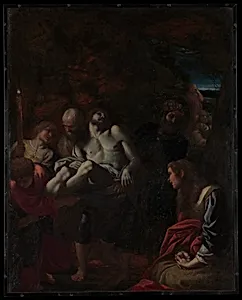
Annibale Carracci's *The Burial of Christ* (1595) captures a poignant moment from the Passion of Christ: the entombment, where Christ's body is tenderly laid to rest after the Crucifixion. Painted in oil on copper—a rare and innovative medium for the time—this small-scale work (17¼ × 13¾ in.) allowed Carracci to achieve extraordinary luminosity and jewel-like detail, evoking devotional intimacy of a private altar piece. Tags like "Sadness," "Mary Magdalene and "Entombment" highlight the emotional core, with the grieving Magdalene likely featured prominently, her sorrow amplifying the scene's devotional power. As a leader of the Bolognese School alongside his brothers, Carracci bridged late Renaissance idealism and emerging Baroque naturalism. Created during the Counter-Reformation era, this painting reflects the Catholic Church's push for emotionally resonant religious art to inspire faith. Carracci's fluid brushwork and dramatic lighting infuse the figures with humanity, making the divine tragedy feel immediate and relatable. Now in the Metropolitan Museum of Art's European Paintings collection (purchased with the Edwin L. Weisl Jr. Gift in 1998), this gem showcases Carracci's mastery in compact form, inviting visitors to contemplate grief, sacrifice, and redemption up close.