
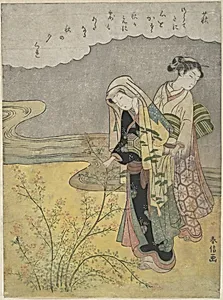
萩|The Bush Clover (Hagi)
ca. 1766
Medium
Woodblock print; ink and color on paper
Dimensions
10 7/8 x 7 7/8 in. (27.6 x 20 cm) medium-size print (chu-ban)
Classification
Prints
Culture & Period
Japan · Edo period (1615–1868)
Department
Asian Art
Museum
Metropolitan Museum of Art, New York, NY
Credit
The Howard Mansfield Collection, Purchase, Rogers Fund, 1936
Accession Number
JP2442
Rights
Public Domain
Tags
Art Historical Context
Step into the vibrant world of Edo-period Japan (1615–1868) with Suzuki Harunobu's *The Bush Clover (Hagi)*, a charming woodblock print from around 1766. Harunobu, a master of ukiyo-e—"pictures of the floating world"—pioneered full-color nishiki-e prints just a year earlier, revolutionizing Japanese art by layering vivid inks to capture fleeting beauty. This medium-size chu-ban print (10 7/8 x 7 7/8 in.) exemplifies his bijin-ga style, delicately portraying elegant women amid nature. The bush clover (hagi), one of Japan's seven flowers of autumn, symbolizes gentle transience and seasonal grace, often evoking poetic nostalgia in Japanese culture. Harunobu's technique shines through precise woodblock carving and hand-rubbed pigments, creating luminous effects on paper that bring the women's kimonos and flowing plants to life. Acquired through The Howard Mansfield Collection at the Metropolitan Museum of Art, this piece highlights the artistry of urban pleasure districts, blending human elegance with nature's poetry. Visitors will appreciate how Harunobu's intimate scale invites close viewing, revealing subtle textures and harmonious colors that defined ukiyo-e's golden age. A timeless gem from the Asian Art collection!
About the Artist
Suzuki Harunobu · 1725–1770
Suzuki Harunobu (c. 1725-1770) was a Japanese ukiyo-e artist who revolutionized woodblock printing by developing nishiki-e—full-color prints using multiple woodblocks—in 1765. Before Harunobu, Japanese prints were limited to two or three colors; his innovation unleashed the entire artist's palette, transforming ukiyo-e into the vibrant art form that would later captivate Western artists from Manet...