
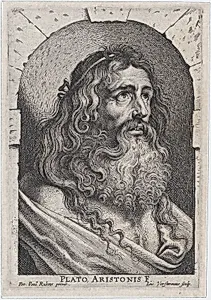
The bust of Plato, in a niche
Medium
Etching and engraving; only state
Dimensions
Plate: 5 3/8 × 3 5/8 in. (13.6 × 9.2 cm) Sheet (Trimmed): 5 5/8 × 3 7/8 in. (14.3 × 9.9 cm)
Classification
Prints
Department
Drawings and Prints
Museum
Metropolitan Museum of Art, New York, NY
Credit
Harris Brisbane Dick Fund, 1917
Accession Number
17.3.1698
Rights
Public Domain
Tags
Art Historical Context
This intriguing print, created around 1620, captures a classical bust of the ancient Greek philosopher Plato nestled within an architectural niche. Produced through combined efforts of Flemish master Peter Paul Rubens and engraver Lucas Vorsterman I, the work exemplifies the collaborative printmaking practices of the Baroque period. Rubens, renowned for his dynamic compositions and vibrant paintings, frequently oversaw the creation of reproductive engravings to share his designs with a wider audience across Europe. Executed in etching and engraving—a technique prized for its ability to render fine details and tonal depth—the image reflects the era’s fascination with classical antiquity. Plato, a foundational thinker whose ideas influenced Renaissance and Baroque humanism, appears here as a timeless emblem of wisdom. Vorsterman’s precise linework, honed during his time in Rubens’s Antwerp workshop, transforms the sculptural subject into a compelling two-dimensional study of form and shadow. Housed in the Metropolitan Museum of Art’s Department of Drawings and Prints, this modest yet refined sheet highlights how 17th-century artists bridged ancient philosophy and contemporary visual culture through the accessible medium of print.