
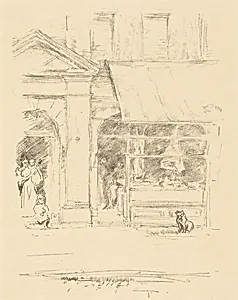
The Butcher's Dog
Medium
lithograph in black on wove paper
Dimensions
image: 18.1 × 13.1 cm (7 1/8 × 5 3/16 in.) sheet: 22.3 × 17.9 cm (8 3/4 × 7 1/16 in.)
Classification
Department
CG-W
Museum
National Gallery of Art, Washington, D.C.
Credit
Rosenwald Collection
Accession Number
1943.3.8782
Rights
Public Domain
Art Historical Context
James McNeill Whistler’s *The Butcher’s Dog* (1896) is a delicate lithograph in black ink on wove paper, an everyday urban moment with the artist’s signature subtlety. Measuring just 18.1 × 13.1 cm, this intimate print belongs to the National Gallery of Art’s Rosenwald Collection and exemplifies Whistler’s late-career mastery of printmaking. Best known for his evocative paintings like *Arrangement in Grey and Black No.1* (often called *Whistler’s Mother*), Whistler championed Aestheticism, prioritizing harmony, tone, and “art for art’s sake” over narrative. Lithography suited Whistler perfectly, allowing him to transfer fluid, drawn lines directly onto stone for rich tonal gradations that mimic charcoal sketches. In this medium, he explored London’s street life during the 1890s, producing series of prints that transformed mundane scenes into poetic compositions. *The Butcher’s Dog* likely evokes the quiet anticipation of a loyal stray amid the city’s bustle, rendered with Whistler’s economical precision—no extraneous details, just masterful suggestion. This work highlights Whistler’s versatility beyond oils, bridging Realism and Impressionism while influencing modern printmakers. Printed on smooth wove paper, it invites close viewing, rewarding visitors with its atmospheric depth and timeless charm. A gem for print enthusiasts!
About the Artist
James McNeill Whistler · 1834–1903
James Abbott McNeill Whistler (1834-1903) was an American-born painter and printmaker who became a leading figure in the Aesthetic Movement and pioneer of Tonalism and Japonisme. He revolutionized art by championing "art for art's sake" and treating paintings as visual equivalents of musical compositions, titling works as "arrangements," "harmonies," and "nocturnes" to emphasize formal qualities o...