
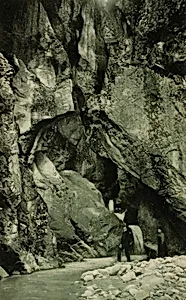
The Cañons of Colorado
Medium
Graphic Arts-Mechanical Reproduction
Classification
Graphic Arts-Mechanical Reproduction
Department
Smithsonian Collection
Museum
Smithsonian American Art Museum
Credit
Smithsonian American Art Museum, Gift of Mr. Ernest Birdseye Bayliss
Accession Number
1995.49.14
Rights
Public Domain
Tags
Art Historical Context
William H. Jackson's *The Cañons of Colorado* captures the dramatic grandeur of Colorado's rugged landscapes, featuring towering rocks, a shadowy cave, flowing water, and possibly a solitary male figure emphasizing human scale against nature's immensity. As a pioneering photographer of the American West, Jackson documented uncharted territories during the late 19th century, often as part of government surveys. This work, a mechanical reproduction in graphic arts—likely a printed version of one of his photographs—allowed his stunning vistas to reach wider audiences through books, magazines, and exhibitions. Jackson's images played a pivotal role in shaping public perception of the West, influencing the creation of national parks like Yellowstone. His expeditions with Ferdinand Hayden's U.S. Geological Survey in the 1870s produced some of the earliest visual records of these remote canyons, blending artistic composition with scientific precision. The mechanical reproduction technique, such as photogravure or lithography, preserved the tonal depth and detail of his original glass-plate negatives, making wilderness exploration accessible to armchair adventurers. Housed in the Smithsonian American Art Museum through a generous gift from Ernest Birdseye Bayliss, this piece exemplifies how Jackson's lens bridged art and exploration, immortalizing Colorado's wild beauty for generations.