
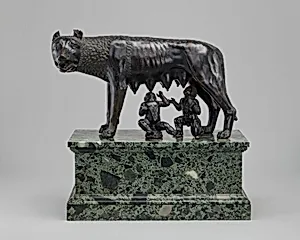
The Capitoline Wolf Suckling Romulus and Remus
late 15th - early 16th century
Medium
bronze
Dimensions
overall (wolf): 38 x 64.2 x 15.9 cm (14 15/16 x 25 1/4 x 6 1/4 in.) overall (height of kneeling twin): 18.1 cm (7 1/8 in.) overall (height of seated twin): 13.7 cm (5 3/8 in.)
Classification
Sculpture
Department
CSD
Museum
National Gallery of Art, Washington, D.C.
Credit
Samuel H. Kress Collection
Accession Number
1957.14.8
Rights
Public Domain
Art Historical Context
This bronze sculpture captures the legendary founding of Rome, depicting a she-wolf nursing the infant twins Romulus and Remus. Created in central Italy during the late fifteenth or early sixteenth century, it revives an ancient Roman myth in which the abandoned brothers were rescued and suckled by a wild animal before growing up to establish the city. The work’s anonymous maker, possibly working in Rome, drew on classical sources to celebrate this foundational story during the Renaissance, a period when artists and patrons enthusiastically rediscovered antique themes. Cast in bronze, the sculpture consists of a larger wolf figure with separately modeled twins, allowing for intricate detailing of fur, muscles, and youthful forms. Measuring roughly 38 by 64 centimeters for the wolf, the piece exemplifies the technical skill of Renaissance bronze casting, a medium prized for its durability and ability to convey both strength and tenderness. Its modest scale suggests it was intended for private contemplation rather than public display. As part of the Samuel H. Kress Collection at the National Gallery of Art, the sculpture reflects the enduring cultural power of Rome’s origin story. By reinterpreting an iconic symbol of Roman identity, the artist connected Renaissance viewers to their ancient heritage while showcasing the period’s refined craftsmanship.