
The Card Players
1890–92
Medium
Oil on canvas
Dimensions
25 3/4 x 32 1/4 in. (65.4 x 81.9 cm)
Classification
Paintings
Department
European Paintings
Museum
Metropolitan Museum of Art, New York, NY
Credit
Bequest of Stephen C. Clark, 1960
Accession Number
61.101.1
Rights
Public Domain
Tags
Art Historical Context
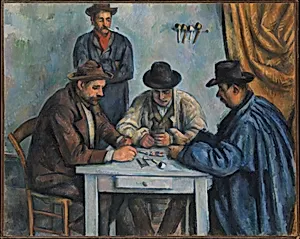
Step into the timeless world of Paul Cézanne's *The Card Players* (1890–92), a masterful oil on canvas now housed in the Metropolitan Museum of Art's European Paintings collection. This intimate yet monumental scene captures two Provençal peasants deeply engrossed in a card game, pipes in hand, amid the earthy simplicity of rural French life. Measuring 25¾ x 32¼ inches, it draws from Cézanne's life at his Jas de Bouffan estate, where he used local workers as models, elevating everyday folk to dignified, almost heroic figures. As a cornerstone of Post-Impressionism, Cézanne revolutionized painting by constructing form through color and brushwork rather than line, laying groundwork for Cubism and modern art. Here, the players' solid, geometric volumes create a stable, pyramid-like composition, with subtle shifts in hue modeling their sturdy bodies and tabletops. The muted palette and textured strokes evoke the harsh light of southern France, blending observation with abstraction. Painted late in his career as part of a renowned series of five similar works, *The Card Players* celebrates the unhurried rituals of peasant life—smoking, gaming—while asserting art's power to reorder reality. Donated through the bequest of Stephen C. Clark in 1960, it invites us to ponder Cézanne's enduring question: How do we see the world anew?
About the Artist
Paul Cézanne · 1839–1906
Paul Cézanne (1839-1906) stands as one of the most influential figures in the history of modern art, often called the "Father of Modern Art" for his revolutionary approach to form, color, and pictorial space. Born in Aix-en-Provence to a wealthy banker who discouraged artistic pursuits, Cézanne rejected a legal career to pursue painting, though he remained financially dependent on his family until...