
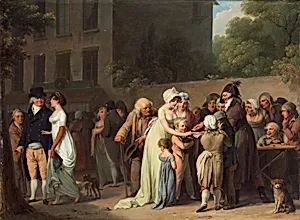
The Card Sharp on the Boulevard
Medium
oil on wood
Dimensions
overall: 24 x 33 cm (9 7/16 x 13 in.) framed: 40.3 x 48.3 x 5.1 cm (15 7/8 x 19 x 2 in.)
Classification
Painting
Department
CF
Museum
National Gallery of Art, Washington, D.C.
Credit
Gift of Victoria and Roger Sant
Accession Number
2000.5.1
Rights
Public Domain
Art Historical Context
Louis-Léopold Boilly *The Card Sharp on the Boulevard (1806) captures a slice of everyday Parisian life in a compact oil-on-wood panel, measuring just 24 x 33 cm. Boilly, a master of French genre painting, excelled at these small-scale works, which allowed for meticulous detail and a jewel-like finish. Painted during the Napoleonic era, when Paris's boulevards buzzed with fashionable strollers and street performers, the medium of wood provided a smooth surface ideal for Boilly's precise brushwork, evoking the intimacy of a snapshot from 19th-century urban hustle. The title hints at a roguish scene: a card sharp—likely a sly gambler tricking passersby—plying his trade amid the boulevard's lively crowd. Boilly's style, rooted in 18th-century realism with nods to Dutch Golden Age masters like Jan Steen, blends sharp observation with subtle humor, highlighting social types from the Directory to Empire periods. These paintings offered viewers a witty mirror to contemporary society, free from lofty history or myth. Housed in the National Gallery of Art as a gift from Victoria and Roger Sant, this gem showcases Boilly's enduring appeal: his ability to elevate the ordinary into artful narrative, inviting us to linger on the drama of daily life.