
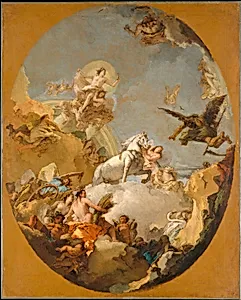
The Chariot of Aurora
Medium
Oil on canvas
Dimensions
35 1/2 x 28 5/8 in. (90.2 x 72.7 cm)
Classification
Paintings
Department
European Paintings
Museum
Metropolitan Museum of Art, New York, NY
Credit
Bequest of Lore Heinemann, in memory of her husband, Dr. Rudolf J. Heinemann, 1996
Accession Number
1997.117.7
Rights
Public Domain
Tags
Art Historical Context
Giovanni Battista Tiepolo's *The Chariot of Aurora* (1760s) is a oil-on-canvas masterpiece exemplifying the exuberant Rococo style of this Venetian master. Painted during Tiepolo's late career it captures the Roman goddess of dawn, Aurora, triumphantly driving her chariot—likely pulled by horses or ethereal steeds—amidst a celestial entourage. Surrounding figures evoke classical mythology, including Apollo, the sun god; Bacchus, god of wine; graceful swans; and dynamic chariots, all rendered in Tiepolo's signature whirlwind of movement and fantasy. Tiepolo, renowned for his grand frescoes in palaces and churches across Europe, brought the same theatrical energy to this more intimate canvas (35½ × 28⅝ in.). His virtuoso technique—vibrant pigments, diaphanous clouds, and flickering light—creates an illusion of boundless sky, immersing viewers in the divine realm. Rococo art like this celebrated lightness and ornament over Baroque drama, reflecting 18th-century Europe's fascination with antiquity amid Enlightenment optimism. Now in the Metropolitan Museum of Art's European Paintings department (Bequest of Lore Heinemann, 1996), this work highlights Tiepolo's enduring influence on decorative painting. Imagine Aurora heralding the day: a poetic reminder of mythology's timeless allure.
About the Artist
Giovanni Battista Tiepolo · 1696–1770
Giovanni Battista Tiepolo (1696-1770) stands as the greatest decorative painter of eighteenth-century Europe, a Venetian master whose luminous frescoes and dynamic compositions defined the Rococo era's aesthetic zenith. Born in Venice on March 5, 1696, to a modest shipping merchant family, Tiepolo's extraordinary talent transcended his humble origins to establish him as the most sought-after artis...