
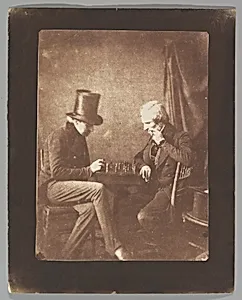
The Chess Players
Medium
Salted paper print from paper negative
Dimensions
Sheet: 9 5/8 × 7 11/16 in. (24.5 × 19.6 cm) Image: 7 13/16 × 5 13/16 in. (19.8 × 14.7 cm)
Classification
Photographs
Department
Photographs
Museum
Metropolitan Museum of Art, New York, NY
Credit
Bequest of Maurice B. Sendak, 2012
Accession Number
2013.159.40
Rights
Public Domain
Tags
Art Historical Context
In the mid-1840s, as photography emerged from its experimental infancy, *The Chess Players* captures a quiet moment of intellectual leisure between two men absorbed in a chess game. around 1845 by Antoine-François Claudet, a pioneering French-born photographer and chemist based in London, in collaboration with his assistant Nicolaas Henneman this salted paper print from a paper exemplifies the calotype process. Invented by William Henry Fox Talbot just a few years earlier, calotype's paper negative allowed for multiple prints from a single exposure—a revolutionary leap from the unique images of daguerreotypes—making photography more accessible and reproducible. The image's soft, matte tones and subtle details, hallmarks of salted paper printing, evoke the era's technical ingenuity. Claudet and Henneman, key figures in London's early photographic scene, often documented portraits and genre scenes like this one, blending scientific precision with artistic observation. Here, the focused gazes and poised figures highlight chess as a gentleman's pursuit, reflecting 19th-century ideals of strategy and camaraderie amid the Industrial Revolution's bustle. Part of the Metropolitan Museum of Art's collection through the bequest of Maurice B. Sendak in 2012, this modest 9 5/8 × 7 11/16-inch print (image 7 13/16 × 5 13/16 inches) stands as a testament to photography's power to freeze everyday humanity, bridging art and science in a transformative medium.