
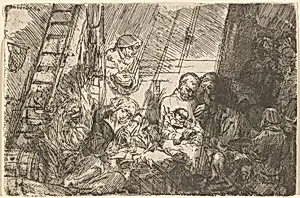
The Circumcision in the Stable
Medium
etching
Classification
Department
CG-E
Museum
National Gallery of Art, Washington, D.C.
Credit
Rosenwald Collection
Accession Number
1943.3.7214
Rights
Public Domain
Art Historical Context
In the heart of Rembrandt van Rijn's masterful etchings, *The Circumcision in the* (1654) captures a tender biblical moment from the Gospel of Luke: the ritual circumcision of the infant Jesus on his eighth day, traditionally performed by a mohel or priest. Rembrandt, at the height of his career during the Dutch Golden Age,imagines this sacred event not in a temple but within the humble stable of the Nativity, emphasizing intimacy and humility amid divine light. This print reflects the artist's deep engagement with religious themes, blending profound spirituality with everyday human emotion—a hallmark of his Baroque style. As an etching, the work showcases Rembrandt's revolutionary printmaking techniques. He skillfully used acid to bite intricate lines into a copper plate, then employed drypoint and burr (raised metal edges) to create velvety textures and dramatic contrasts of light and shadow, known as chiaroscuro. These innovations elevated etching from mere reproduction to a painterly art form, allowing subtle tonal gradations that draw viewers into the scene's emotional depth. Printed during a period of personal hardship for Rembrandt, it exemplifies his ability to infuse technical brilliance with spiritual resonance. Housed in the National Gallery of Art's Rosenwald Collection (Department CG-E), this print invites visitors to ponder faith's quiet miracles. Rembrandt produced only a few impressions, making it a rare treasure that bridges 17th-century devotion and timeless artistry.
About the Artist
Rembrandt van Rijn · 1606–1669
Rembrandt Harmenszoon van Rijn (1606–1669) stands as one of the greatest visual artists in the history of Western art and the most important Dutch painter of the 17th century. Born in Leiden to a prosperous miller's family, Rembrandt transformed painting through his revolutionary use of light and shadow, his psychological depth in portraiture, and his elevation of etching to a fine art. His approx...