
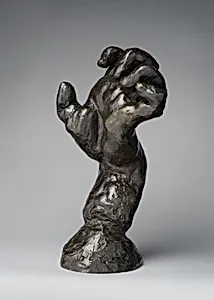
The Clenched Left Hand (Study for Hand of Pierre de Wiessant)
modeled ca. 1885, cast 1974
Medium
Bronze
Dimensions
Overall (wt. confirmed): 18 1/4 × 10 3/8 × 7 5/8 in., 23.1 lb. (46.4 × 26.4 × 19.4 cm, 10.5 kg)
Classification
Sculpture-Bronze
Culture
French
Department
European Sculpture and Decorative Arts
Museum
Metropolitan Museum of Art, New York, NY
Credit
Gift of Iris and B. Gerald Cantor Foundation, 1984
Accession Number
1984.364.13
Rights
Public Domain
Tags
Art Historical Context
Auguste Rodin, the pioneering French sculptor of the late 19th, created *The Clenched Left Hand (Study for Hand of Pierre Wiessant)* around 1885 as part of his preparatory work for the monumental *The Burghers of Calais* (1884–1889). This study captures the tense, gripping fist of Pierre de Wiessant, one the six burghers heroically offered themselves to save Calais during the Hundred Years' War. Rod innovative approach rejected the smooth idealism of academic sculpture, favoring raw, fragmented forms that pulsed with human emotion and psychological depth. Rendered in bronze and cast posthumously in 1974 by the skilled foundry Georges Rudier, this 18¼-inch sculpture exemplifies Rodin's meticulous technique of isolating body parts for study. Hands, in particular, fascinated him as bearers of intense feeling—here, the clenched fingers evoke defiance, sacrifice, and resolve. Such studies allowed Rodin to infuse his larger compositions with lifelike vitality, revolutionizing modern sculpture. Now in the Metropolitan Museum of Art's European Sculpture and Decorative Arts collection, thanks to a 1984 gift from the Iris and B. Gerald Cantor Foundation, this piece invites visitors to appreciate the tactile power of Rodin's vision up close.
About the Artist
Auguste Rodin|Georges Rudier · 1840–1917
François Auguste René Rodin (1840-1917) stands as the founder of modern sculpture, transforming the art form from academic tradition into expressive modernism. Born into a working-class Parisian family, Rodin faced early rejection, failing three times to gain admission to the prestigious École des Beaux-Arts. This setback forced him to work as a craftsman for nearly two decades, though his 1875 tr...