
The Cliff, Bay of St. Malmo
1889–90
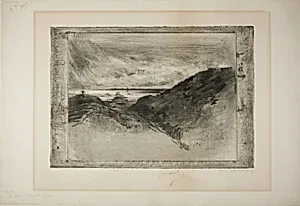
Medium
Etching, drypoint, and aquatint on white wove paper
Dimensions
Plate: 24.8 × 35.5 cm (9 13/16 × 14 in.); Sheet: 35.9 × 52.6 cm (14 3/16 × 20 3/4 in.)
Classification
etching
Department
Prints and Drawings
Museum
Art Institute of Chicago
Accession Number
21028
Rights
Public Domain
Art Historical Context
Félix Hilaire Buhot's *The Cliff, Bay of. Malo* (1889–90) captures rugged beauty of Brittany's coastline in France, showcasing the artist's mastery of printmaking during the late 19th etching revival. Buhot, a innovative French etcher influenced by Impressionist light and atmosphere, rendered this dramatic seascape on white wove paper, with plate dimensions of 24.8 × 35.5 cm. Housed in the Art Institute of Chicago's Prints Drawings department, the work exemplifies how prints democratized art, allowing intricate details to reach broader audiences beyond oil paintings. Buhot employed a virtuoso combination of etching, drypoint, and aquatint techniques. Etching provided precise lines for cliffs and waves, drypoint added velvety burrs for texture and depth, and aquatint created subtle tonal gradations mimicking watercolor washes—ideal for evoking the Bay of St. Malo's moody skies and shimmering waters. This mixed-method approach, for which Buhot was renowned, pushed printmaking toward painterly expressiveness, bridging traditional engraving with modern experimentation. As a testament to fin-de-siècle innovation, the print reflects Buhot's passion for capturing fleeting natural effects, inviting viewers to ponder the interplay of light, rock, and sea. A gem for print enthusiasts, it highlights the enduring allure of technical prowess in visual storytelling.