
The Cobbler's Cure for a Scolding Wife
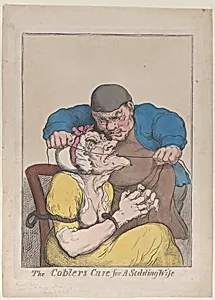
Medium
Hand-colored etching; reverse copy
Dimensions
Plate: 13 × 9 5/8 in. (33 × 24.4 cm) Sheet: 15 3/16 in. × 11 in. (38.6 × 28 cm)
Classification
Prints
Department
Drawings and Prints
Museum
Metropolitan Museum of Art, New York, NY
Credit
The Elisha Whittelsey Collection, The Elisha Whittelsey Fund and Harris Brisbane Dick Fund, by Exchange, 1970
Accession Number
1970.541.17
Rights
Public Domain
Tags
Art Historical Context
Thomas Rowlandson’s 1813 print *The Cobbler’s Cure for a Scolding* exemplifies the lively tradition of British satirical etching during the Regency era. Rowlandson, celebrated for his sharp caricatures of everyday life, used exaggerated figures and witty titles to comment on social customs, particularly the tensions of marriage. Created as a hand-colored etching and noted as a reverse copy, the work was designed for broad circulation, allowing middle-class audiences to enjoy affordable, colorful commentary on domestic relations. Etchings like this one were printed from metal plates and then delicately tinted by hand, a technique that made satire both accessible and visually. The reverse-copy format suggests the image’s popularity, as printers often reproduced successful designs—sometimes in mirror image—to meet public demand. Through its focus on men and women, the print captures the era’s humorous, if pointed, exploration of gender roles and household power dynamics. Housed in the Metropolitan Museum of Art’s Department of Drawings and Prints, this work remains a vivid reminder of how visual satire shaped public conversation in early nineteenth-century Britain.
About the Artist
Thomas Rowlandson · 1756–1827
Thomas Rowlandson (1757–1827) was an English artist and caricaturist whose satirical watercolors and prints captured the social life of Georgian Britain with unparalleled wit and technical mastery. Alongside James Gillray, he is recognized as one of the greatest British graphic artists, and his distinctive flowing line and keen observations have made his work integral to understanding late 18th an...