
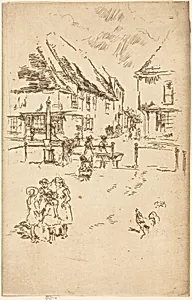
The Cock and the Pump
c. 1887
Medium
etching on laid paper
Dimensions
overall (trimmed to plate): 22 × 14.1 cm (8 11/16 × 5 9/16 in.)
Classification
Department
CG-W
Museum
National Gallery of Art, Washington, D.C.
Credit
Rosenwald Collection
Accession Number
1943.3.8603
Rights
Public Domain
Art Historical Context
James McNeill Whistler created this intimate etching around 1887 during a period when he was exploring everyday urban and rural motifs with remarkable delicacy. An American-born artist who spent much of his career in Britain and France, Whistler was a leading figure in the Aesthetic movement, favoring suggestion and tonal harmony over narrative detail. His etchings from this era often captured fleeting impressions of streets, harbors, and architectural elements, reflecting his interest in Japanese compositional principles and the beauty of ordinary subjects. Printed on laid paper and trimmed to the plate, the work measures just over eight inches in height, underscoring the personal scale typical of Whistler’s printmaking. Etching allowed him to achieve fine, spontaneous lines that convey both precision and atmosphere, a technique he refined through multiple states and careful inking. As part of the Rosenwald Collection at the National Gallery of Art, this print exemplifies how Whistler elevated the medium from reproductive tool to independent art form, influencing generations of printmakers. Visitors may notice the subtle interplay of light and shadow that characterizes Whistler’s late etchings, inviting quiet contemplation rather than dramatic storytelling.
About the Artist
James McNeill Whistler · 1834–1903
James Abbott McNeill Whistler (1834-1903) was an American-born painter and printmaker who became a leading figure in the Aesthetic Movement and pioneer of Tonalism and Japonisme. He revolutionized art by championing "art for art's sake" and treating paintings as visual equivalents of musical compositions, titling works as "arrangements," "harmonies," and "nocturnes" to emphasize formal qualities o...