
The Colosseum Seen from the Palatine Hill
1860s(?)
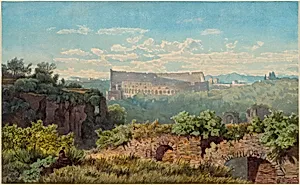
Medium
watercolor and gouache over traces of graphite, touched with gum arabic, on wove paper
Dimensions
sheet: 19.7 × 32.1 cm (7 3/4 × 12 5/8 in.)
Classification
Drawing
Department
CG-E
Museum
National Gallery of Art, Washington, D.C.
Credit
Ailsa Mellon Bruce Fund
Accession Number
2015.73.2
Rights
Public Domain
Art Historical Context
Behold the majestic ruins of Rome's Colosseum as captured in Julius Zielke's *The Colosseum Seen the Palatine Hill*, delicate watercolor and gouache from the 1860s. Perched atop the Palatine Hill—one of the Seven Hills and the heart of ancient Rome—this vantage point offers a sweeping vista of the iconic amphitheater, ev the grandeur of the Roman Empire amid its weathered stones. Zielke, a lesser-known 19th-century artist, created this during the era of the Grand Tour, when travelers flocked to Italy to sketch classical antiquities, blending Romantic reverence for the past with emerging realism. Crafted on wove paper (19.7 × 32.1 cm), the work layers transparent watercolors and opaque gouache over faint graphite sketches, heightened with gum arabic for a subtle sheen that mimics sunlight on ancient marble. This mixed-media technique allows for intricate details—the archways' shadows, the hill's foliage—while conveying atmospheric depth, a hallmark of 19th-century landscape drawings prized for their portability and immediacy. Housed in the National Gallery of Art through the Ailsa Mellon Bruce Fund, this piece invites us to ponder Rome's enduring legacy: a symbol of imperial might now softened by time and nature, reminding visitors of history's poetic decay.