
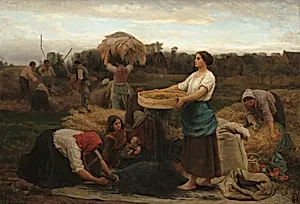
The Colza (Harvesting Rapeseed)
1860
Medium
oil on canvas
Dimensions
overall: 93.98 × 137.16 cm (37 × 54 in.) framed: 128.27 × 172.72 × 17.15 cm (50 1/2 × 68 × 6 3/4 in.)
Classification
Painting
Department
CF
Museum
National Gallery of Art, Washington, D.C.
Credit
Corcoran Collection (William A. Clark Collection)
Accession Number
2014.136.21
Rights
Public Domain
Art Historical Context
Jules Breton's *The Colza (Har Rapeseed)*, painted 1860, captures the timeless rhythm of rural French life during the harvest season. This large oil on canvas (93.98 × 137.16 cm) depicts women and workers gathering vibrant yellow rapeseed under a vast sky, a scene that embodies Breton's signature blend of and poetic idealism. As a leading figure in the Realist movement, Breton drew inspiration from everyday peasant labor, much like his contemporary Jean-François Millet, but infused his works with a luminous, almost golden glow that elevates the ordinary to the sublime. Created amid France's Second Empire, when industrialization was transforming the countryside, the painting reflects a nostalgic celebration of agrarian traditions. Oil on canvas allowed Breton to masterfully render the textured fields, delicate flowers, and dynamic figures with rich impasto and subtle light effects, drawing viewers into the warmth of communal toil. Its monumental scale enhances its immersive quality, making it a centerpiece in the Corcoran Collection at the National Gallery of Art. This artwork not only showcases Breton's technical prowess but also holds cultural resonance as a tribute to the dignity of rural workers, offering 19th-century audiences—and us today—a serene escape into nature's enduring cycle.