
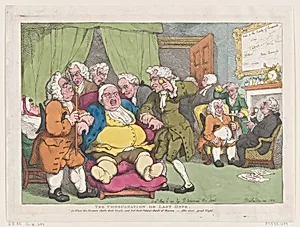
The Consultation, or Last Hope
June 30, 1808
Medium
Hand-colored etching
Dimensions
Sheet: 11 1/16 × 14 11/16 in. (28.1 × 37.3 cm) Plate: 10 3/16 × 13 15/16 in. (25.8 × 35.4 cm)
Classification
Prints
Department
Drawings and Prints
Museum
Metropolitan Museum of Art, New York, NY
Credit
The Elisha Whittelsey Collection, The Elisha Whittelsey Fund, 1959
Accession Number
59.533.1099
Rights
Public Domain
Tags
Art Historical Context
**The Consultation, or Last Hope** is a lively hand-colored etching created in 1808 by George Murgatroyd Woodward, who designed the composition, and Thomas Rowlandson the renowned British caricaturist who etched colored it. Measuring about 11 by 14 inches, this exemplifies the satirical genre that flourished in Regency-era Britain, where artists like Rowlandson skewered follies through exaggerated, humorous scenes. Produced amid the Napoleonic Wars and a booming market for affordable caricature prints, it reflects the era's appetite for witty commentary on everyday absurdities. The title hints at a desperate "consultation"—likely a mock-serious gathering of men, as suggested by the tags for satire, men, and drinking. Rowlandson's signature style blends sharp line work with vibrant hand-coloring, adding cheeky realism to the chaos: flushed faces, tumbling figures, and exaggerated expressions that poke fun at human vices. Hand-coloring, applied post-printing, heightened the visual punch, making these etchings popular collectibles sold in London shops. Housed in the Metropolitan Museum of Art's Elisha Whittelsey Collection, this work showcases Rowlandson's mastery of social satire, capturing the boisterous spirit of early 19th-century tavern life and the era's blend of humor and critique. A delightful glimpse into Georgian mischief! (198 words)
About the Artist
George Murgatroyd Woodward|Thomas Rowlandson · 1765–1809
**George Murgatroyd Woodward (1765–1809)**, often known as George “Moutard” or “Mustard” Woodward, was an English caricaturist and humor writer whose energetic, sometimes crude drawings captured the social follies of late Georgian Britain. Born at Stanton Hall in Stanton by Dale, Derbyshire, as the son of William Woodward, he grew up in the county before moving to London around 1791–92. Woodward ...