
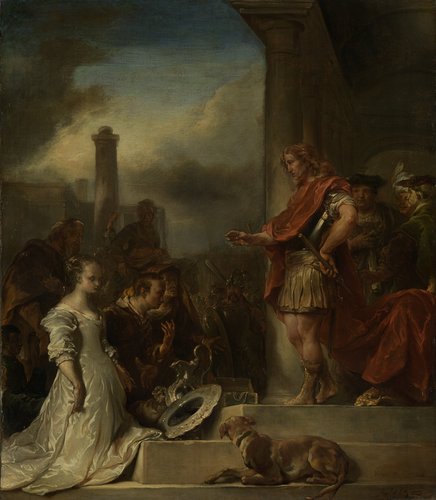
The continence of Scipio
Medium
oil on canvas
Dimensions
88; 6.5; 103
Rights
Public Domain
About this artwork
buitenmaat: diepte 6,5 cm (drager incl. SK-L-1931)
Art Historical Context
**The Continence of Scipio (1672) by Jan vant (1623–1676) is a striking oil-on-canvas history painting measuring 103 × 88 cm, housed in the Rijks. It depicts a pivotal moment from ancient Roman history: the virtuous general Scipio Africanus,or of Hannibal, returns a beautiful captive bride to her betrothed rather than claiming her as spoils of war. This act of "continence" or self-restraint exemplifies classical ideals of honor and magnanimity, a popular moral tale in Renaissance and Baroque art. Noordt, a Dutch Golden Age painter active in Amsterdam, drew from the dramatic flair of Rubens and Rembrandt, infusing his works with theatrical compositions, rich color contrasts, and expressive figures in flowing drapery. Painted during a time when history paintings served as edifying spectacles for elite patrons, this piece reflects the era's fascination with antiquity as a mirror for contemporary virtue amid the Dutch Republic's prosperity and moral debates. The canvas's intimate scale belies its grandeur, inviting viewers to ponder timeless themes of power and restraint. Noordt's masterful handling of oil—evident in luminous skin tones and shadowed depths—highlights his skill in capturing emotional intensity, making this a gem of 17th-century Baroque narrative art in the Rijksmuseum's collection.