
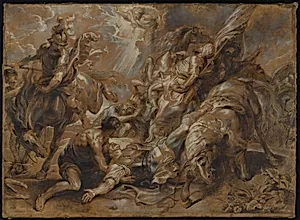
The Conversion of Saint Paul
Medium
pen and ink and oil paint over black chalk on brown paper, laid down on canvas
Dimensions
overall: 43.2 x 60.3 cm (17 x 23 3/4 in.)
Classification
Drawing
Department
CG-E
Museum
National Gallery of Art, Washington, D.C.
Credit
Pepita Milmore Memorial Fund
Accession Number
1999.25.1
Rights
Public Domain
Art Historical Context
Behold *The Conversion of Saint Paul a captivating 17th-century drawing by Abraham van Diepenbeeck created after a design by the Baroque master Peter Paul Rubens in the 1640s. This work depicts the dramatic biblical moment when Saul, on the road to Damascus, is struck blind by divine light and transformed into the apostle Paul—a pivotal scene in Christian theology symbolizing sudden conversion and redemption. Housed in the National Gallery Art, it measures 43.2 x 60.3 cm and was through the Pepita Milmore Memorial Fund. Executed in pen and ink with oil paint over black chalk on brown paper (later laid down on canvas), this piece exemplifies the innovative "oil sketch" technique popular in Rubens' Antwerp workshop. Diepenbeeck, a skilled Flemish artist and collaborator in Rubens' circle, faithfully captured the master's dynamic composition, rich chiaroscuro, and swirling energy characteristic of Flemish Baroque art. Such preparatory drawings served as modelli—detailed studies for larger paintings or tapestries—highlighting the collaborative spirit of 17th-century studios during the Counter-Reformation, when vivid religious imagery aimed to inspire faith. This rare survivor offers a window into Rubens' enduring influence, even after his death in 1640, blending meticulous draftsmanship with painterly freedom. Visitors will appreciate its tactile immediacy, evoking the thunderous drama of divine intervention on a modest scale.