
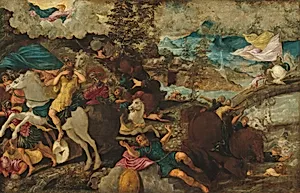
The Conversion of Saint Paul
c. 1544
Medium
oil on canvas
Dimensions
overall: 152.7 × 236.3 cm (60 1/8 × 93 1/16 in.) framed: 193 x 276.2 x 14.9 cm (76 x 108 3/4 x 5 7/8 in.) gross weight: 106.595 kg (235 lb.)
Classification
Painting
Department
CIS-R
Museum
National Gallery of Art, Washington, D.C.
Credit
Samuel H. Kress Collection
Accession Number
1961.9.43
Rights
Public Domain
Art Historical Context
**The Conversion of Saint Paul (c. 1544) by Jacopo Tintoret marks an early triumph for the Venetian master, painted when he was just in his mid-twenties. This large-scale oil on canvas (1527 × 236.3 cm) captures the dramatic biblical moment when Saul, en route to Damascus to persecute Christians, is blind by a divine light and transformed into the apostle Paul. Acquired through the Samuel H. Kress Collection and now housed in the National of Art's CIS-R department, it exemplifies Tintoretto's bold entry into Venice's competitive art scene. Tintoretto, nicknamed "Il Furioso" for his energetic style, bridges Renaissance harmony with emerging Mannerism through dynamic compositions and intense lighting. Oil on canvas allowed him the flexibility to achieve vivid colors and textures, ideal for grand religious narratives demanded by Counter-Reformation patrons. This work's monumental size suited church altarpieces, immersing viewers in the miracle's spiritual intensity. A fascinating fact: at over 106 kg framed, its sheer physical presence underscores Tintoretto's ambition to rival titans like Titian. For visitors, it offers a window into 16th-century Venice's fervent faith and artistic innovation, inviting reflection on transformation and divine intervention.
About the Artist
Jacopo Tintoretto · 1518–1594
'Tintoretto' was nicknamed 'little dyer' for his father's humble occupation of 'tintore' ( a dyer), and 'il Furioso' for his violent application of paint. His work was sometimes criticized as being hastily executed and unfinished during his lifetime, but he was among the most influential and prominent Venetian painters of his time. Except for visiting Mantua around 1580, Tintoretto stayed in Venic...